UOW TronSoc Rover Team
Designing, manufacturing and assembling a prototype lunar rover.
30 Teams
5th
2026
24 Teams
14 Teams
2024
Originally the UOW Rover Team, the UOW TronSoc Rover Team has been an integral part of the Mechatronics Society since the clubs refoundation in 2023. Growing from just 8 members at its debut attending ARCh 2024 to over 20 members for ARCh 2026.
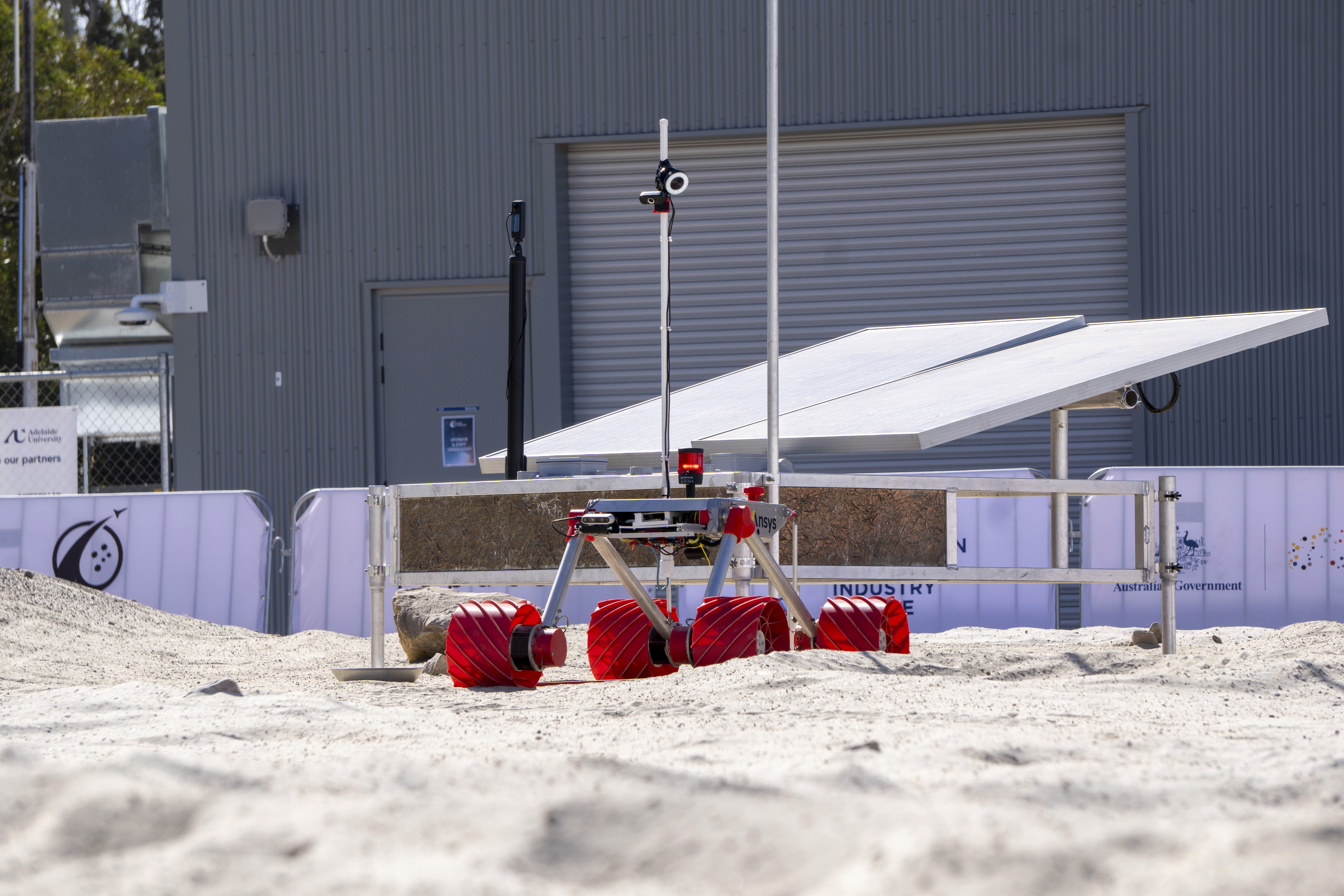
Each year, they design, manufacture, assemble and program a prototype lunar rover to compete at the Australian Rover Challenge. Through these core engineering processes, students from Australia and around the world develop practical engineering and project management skills giving real-world experience before going out into industry.
The Australian Rover Challenge is hosted in Adelaide each year around March. The challenge includes four major tasks which teams can compete in across the four days of the competition:
Post Landing, Space Resources, Excavation & Construction, Autonomous Mapping.
These tasks require teams to complete assignments related to the Australian Government's goal of establishing a human colony on the southern pole of the Moon, including lander diagnostics and repair, water extraction, resource detection, berm construction, infrastructure deployment, debris clearing and the autonomous mapping of the landing site. The competition is held at the Exterres CRATER Facility in Adelaide, a lunar-simulation testing facility where real lunar testing is conducted.
The pitch teams compete on is designed to closely simulate the regolith, terrain and debris humans would likely encounter on the lunar surface, meaning that the rovers student-engineers are designing need to be capable of traversing the lunar environment.
The Australian Rover Challenge is hosted in Adelaide each year around March. The challenge includes four major tasks which teams can compete in across the four days of the competition:
Post Landing, Space Resources, Excavation & Construction, Autonomous Mapping.
These tasks require teams to complete assignments related to the Australian Government's goal of establishing a human colony on the southern pole of the Moon, including lander diagnostics and repair, water extraction, resource detection, berm construction, infrastructure deployment, debris clearing and the autonomous mapping of the landing site. The competition is held at the Exterres CRATER Facility in Adelaide, a lunar-simulation testing facility where real lunar testing is conducted.
The pitch teams compete on is designed to closely simulate the regolith, terrain and debris humans would likely encounter on the lunar surface, meaning that the rovers student-engineers are designing need to be capable of traversing the lunar environment.